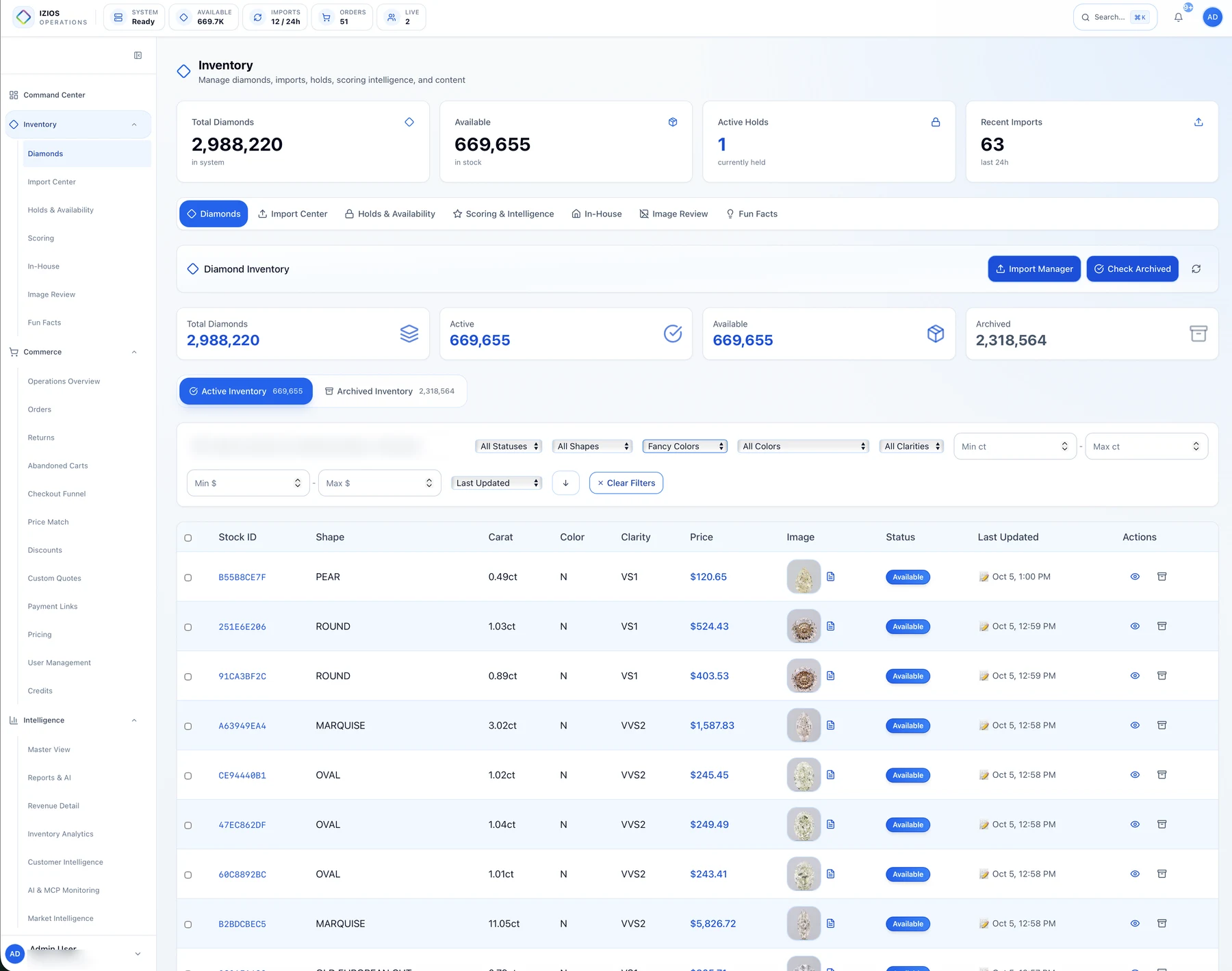
IZIOS inventory operations, October 5, 2026.

Product data / Search / API infrastructure

IZIOS

The systems behind
a searchable market.

Hypler developed IZIOS as connected product infrastructure: supplier ingestion, a normalized diamond catalog, search, reusable APIs, and the workflows that carry discovery into commerce.

Interface evidence

Inside the product.

Documented product captures, not live inventory. Features, availability, and listing values evolve.

IZIOS inventory operations, October 5, 2026; supplier search text and admin email blurred for privacy.

Inventory operations

Inventory, imports, holds, archived records, filtering, and operational review in one administrative surface.

  • Active and archived inventory scope
  • Import and availability controls
  • Commerce and intelligence navigation

IZIOS inventory operations, October 5, 2026.

The engineering problem

One product experience. Many systems underneath.

Supplier feeds do not arrive as one clean, stable catalog. Specifications, identifiers, availability, certificates, and media need a shared structure before they can support useful search or a dependable API.

The work spans the frontend and the backend: translating inventory into product records, keeping changes synchronized, exposing retrieval interfaces, and connecting them to customer and administrative workflows.

A June 2026 project record documented more than 1.8 million active and archived records across the platform's catalog history.

Platform scope

From supplier records to operating systems.

Supplier ingestion and synchronization

Normalize inventory from different suppliers into a consistent catalog. Incremental synchronization and checksum-based change detection limit unnecessary reprocessing while preserving source identity and update context.

Catalog, retrieval, and product evidence

PostgreSQL-backed product records connect specifications, certificates, availability, and listing evidence. Structured filters and pgvector-backed semantic retrieval serve distinct discovery needs with source records kept visible.

APIs and connected commerce

Reusable diamond data APIs support integrations beyond the primary storefront. Customer, cart, hold, and payment workflows retain separate responsibilities from discovery through transaction.

Administrative and source-health surfaces

Source-health interfaces and administrative review connect the public product to the systems behind it. Operators need to distinguish supplier changes, ingestion failures, incomplete evidence, and customer-facing outcomes.

Technology reference

IZIOS implementation choices

IZIOS processes supplier inputs into normalized records, combines structured filters with vector retrieval, serves product data through APIs, and keeps commerce transactions separate from availability truth.

  1. Supplier ingestion
  2. Normalized records
  3. Structured filters and vector retrieval
  4. APIs
  5. Commerce transactions

These are documented implementation choices. Supplier availability remains source-controlled; compile-time contracts and runtime validation serve different checks.

React logo
React

Client interface

Builds reusable customer and administrative interface components.

Why here: Keeps discovery, operations, and review surfaces composed from shared UI parts.

Express logo
Express

HTTP API

Routes product, account, and operational requests through server middleware.

Why here: Provides a defined API boundary for connected clients and workflows.

PostgreSQL logo
PostgreSQL

Relational records

Stores durable catalog, workflow, and transaction records.

Why here: Supports joins, constraints, and transactional changes where product data must stay reviewable.

PostgreSQL logo
pgvector

Vector retrieval

Stores embeddings with relational records and compares vectors by similarity.

Why here: Supports broader-intent discovery while structured filters keep exact constraints explicit.

SI with a defined role

Structured discovery. Source records remain visible.

Diamond Scout and AI-assisted search turn a person's criteria into a discovery workflow. Structured filters apply exact constraints; semantic retrieval supports broader intent.

LightScore analyzes certificate and listing information. Physical optical performance requires measured evidence. Product records keep availability and source evidence available for review.

The source-aware data pattern

What the work demonstrates

Data, search, and transaction boundaries.

The platform connects ingestion, data contracts, search, API consumers, operational visibility, and transaction boundaries. Each interface keeps its input, output, and operating role clear.

Discuss your platform